Pages

Showing posts with label veganism. Show all posts

Wednesday, December 28, 2016

Stop Making Carrie Fisher's Heart Attack about your Sexist Agenda -- and stop Coopting Veganism to do It

I just read Neal Barnard's blog where he takes Carrie Fisher to task for having a heart attack and then schools all women (white women?) about how we should all be taking better care of ourselves by eating a more plant-based diet.


“I tell my younger friends that no matter how I go, I want it reported that I drowned in moonlight, strangled by my own bra.” Yeah, she said that.  Also: FU, because she would say FU.

First of all, I love me some plant-based diet; I've been on one since 1988 or so. Hey!  I wrote a book about veganism in American culture and am married to a super successful vegan chef.

Second of all, we have no actual intel on what happened to Fisher.  Third, this is the most sexist shit I can imagine.  Did he do this when George Michael died of confirmed heart failure?  Or when Ricky Harris died of a heart attack? No?  Right.  Because Neal Barnard sees Carrie Fisher's death as an "in" to target women who should be vegan to avoid heart attack.  Nothing is more patronizing or infuriating for yours truly than this noise.

When I checked out of the hospital after nearly a week stay post massive heart attack caused by SCAD, a genetic variable that no one thought to research until -- gasp! -- the last 20 years, I was one of the lucky ones who survived what is normally called a widow maker  Most cases of SCAD, prior to Sharonne Hayes's EXTREMELY important study of it, had been discovered post-mortem, because most of us died before being diagnosed. 

Here's my heart attack.  Those really weird things at the bottom of the page?  That ECG pattern is called "tombstoning."  Because you don't come back from those.


Yup: this is me, 10 minutes from "nite, nite."


Can I get a "hell, yeah?"

Where is the research on women's heart attacks?  When I left the hospital, I got a brochure -- illustrated! -- about how to play golf post-heart attack and how to get the wife to clean the house.  

Hey, beeatach: I need for you to vacuum the living room.  Cool?

If Neal Barnard would like to talk to me about my experience with SCAD, as a VEGAN woman with NO risk factors who nearly died, then he should email me (lwright@email.wcu.edu).  I would love for him and every other cardiologist in the country to examine and understand the ways in which women die from their fucked up hearts.  And many of us die regardless of the care we take.

But shaming a dead woman and trying to get the rest of your readership to go vegan because of an undiagnosed medial issue?  For that, my friend, you should be ashamed.

And, here's my letter to you.  Peace, from a person who survived a heart attack that very likely would have killed you.

Hi Neal,
I'm a vegan woman who nearly died from SCAD in 2013. I find the medical profession's treatment of women's heart isses to be unbelievably sexist -- and I think that your article is contributing to that sexism, even as it's simultaneously unbelievably inconsiderate of Fisher's death. We have no idea what caused her to die; many of my fellow SCAD survivors feel that it might well be SCAD, and if you have SCAD, it's not your fault. Not that she should be made to be a fault regardless.

I have been vegetarian since 1988 and vegan since 2000. I am a long distance runner with no history 
of tobacco use or subtance abuse, and I nearly died on October 25, 2015 due to a spontaneous coronary artery dissection (which was diagnosed finally after I sought a 3rd opinion from Dr. Sharonne Hayes at the Mayo Clinic a year later).

I'm in a FB group for SCAD survivors -- along with 1000+ other people, mostly really, really heath-conscious women who have had at least one and sometimes multiple heart attacks, many of them massive (mine was a widow maker) despite our best efforts. If you'd like to read my about my heart or my veganism, you can do so here: http://veganbodyproject.blogspot.com/.../hillarys-health.... And here's a link to my most recent book: http://www.ugapress.org/.../books/the_vegan_studies_project

If you'd like to get more information about SCAD, about the ways that it's almost entirely unique to otherwise healthy (even vegan) women, please feel free to contact me. Your readers are welcome as well: lwright@email.wcu.edu
Thanks,
Dr. Laura Wright, Ph.D.
Professor of English

Saturday, October 20, 2012

Out of the Closet? Veganism as Orientation or Preference


I was running, stepped on a rock, rolled and then broke my right ankle on October 3.  I’ve never broken a bone before, and I can tell you that of all the bones I could have broken, my right ankle would not be my first choice.  Things I’m observing while trying to heal: there’s nothing worse than a runner who can’t run.  I am currently in a space of telling off random strangers in other people’s Facebook posts (I’ve forbidden myself from FB for a week as a result of telling off a friend’s friend for trying to mansplain why veganism is bad), nearly punching the last person who told me that at least I’m getting good upper body workout from the crutches, and sending a nasty letter to some random news station after reading a horribly written and factually inaccurate article about Mickey Shunick’s murderer.  I corrected the article using Track Changes and requested that those folks hire an English major. 

 Again, hire an English Major.


So I’m in a rare space that constitutes a haphazard mixture of rage at not being able to run and the subsequent depression resultant from such a state, feminist ire from reading too much social media (binders full of women!) – a position that arises from my inability to do much of anything else – and generalized misanthropy, aimed at

1.  Anyone walking, running, or driving, all of which I can’t do
2.  My neighbors, whose Romney/Ryan sign keeps creeping closer and closer to my yard
3.  The gym that I’ve joined (cause rowing machines and exercise bikes suck and are not even remotely as awesome as running)
4.  Anyone who doesn’t offer to hold a door for me when I’m trying to get into the gym (cause I can’t open doors and manage crutches)
5.  Anyone who offers to hold a door for me (cause don’t feel sorry for me, asshole!)

You see my predicament.  I’m a miserable bastard, and there is no making it better til I can run again.  Anyway, I have been doing a lot of reading and writing and thinking.  Here’s what’s new.


But first, here are my ankles.  The one that looks like a loaf of bread is the one that's broken.

I went out to dinner about a month ago with three people, two of whom are friends, and the other someone I’d just met.  While we were ordering, one of my friends shared with the new friend that I’m vegan.  I don’t mind this at all; I am, at present, wearing that status like a gigantic badge of honor (“vegan” tattooed on my arm and all), so it’s not like I’m trying to hide that fact from anyone.

This hasn’t always been the case.  For a long time, I was very private about both my vegetarianism (when I was a vegetarian) and my veganism (after I became vegan) for a whole variety of reasons, the most prominent of which was that I didn’t want to make other people feel uncomfortable or judged.  Another reason was that I’d found that often when I would disclose my dietary weirdness, there would ensue all manner of things that I didn’t want to deal with: people telling me their stories of their failed attempts at vegetarianism (usually something along the lines of “I used to be vegetarian, but then I got sick…”), questions about where I got my protein, and, sometimes, worst of all, blatant attacks on my lifestyle.

Now, however, I don’t care about whether or not I make people uncomfortable.  I’m not judging anyone; I just refuse to self-judge to protect other people’s feelings.  It took me a long to get here, and I’m not leaving.

So when my friend outed me as vegan, there was that moment that I always feel when this happens around someone I don’t know, when I wonder how I’ll be treated thereafter.  This new friend was very nice; she thanked me for being a “normal” vegan, as she’d known quite a few who weren’t.  And then she told me about them. 

On the one hand, it’s nice to be the friendly face of non-judgmental veganism, to be the “normal” one among so many weirdos, despite the fact that there’s nothing at all normal about me. I exist within a subculture that constitutes at most something like 3% of the U.S. population, and our very existence (and I’m seriously not trying to speak for vegans as a whole because we are not in any way a unified movement) is about as counter-cultural as anything that’s out there. 

Here’s what happened when I told my friend Will about being a normal vegan.  He said, “Oh my God.  That’s exactly what happens to me, only I’m the ‘normal’ gay guy.”

The whole experience got me thinking about the way that veganism, like homosexuality, constitutes a non-normative identity position that requires one to constantly negotiate whether to be in or out of the closet, and, should one come out, to manage other people’s reactions to that position.  Sex and food: two of our most primal and primary needs; mess with how the majority of folks think you should fuck or eat, and watch what happens.


To take this comparison further, a 2007 study by Annie Potts and Jovian Parry even explores the emergence of “a new ‘sexual preference’ and a new controversy [that subsequently] appeared in the global media-scape and on the internet: ‘vegansexuality’” (53), which surfaced after a 2006 nationwide New Zealand study that looked at the perspectives of vegetarian and vegan consumers in that country.  Several vegetarian female respondents – only one of whom identified as vegan – noted that they engaged in sexual and long-term relationships only with others who likewise abstained from meat and animal products.  Potts and Parry note that in subsequent news stories, the term “vegansexual” was coined to define this phenomenon and that the global coverage of it “was, predictably, highly sensationalized” (55). 

The backlash that ensued was aimed at women who would dare to express this new sexual orientation – and Potts and Parry read vegansexuality in Foucauldian terms, noting its creation “through various machinations of power and resilience, discourse and confession” (55) – with the most vitriolic contempt for vegansexuality coming from omnivorous heterosexual men (57). The various criticisms from this group aimed at women who express this orientation include the assertion that both veganism and sex with only vegan men constitute a form of self-imposed abstinence by women who really prefer meat eaters – and meat – “but deny their ‘true’ desires,” or as dietary and sexual dysfunction, a deficiency, and/or a form of discrimination against men who eat meat (64). 

My attempt to consider veganism as somehow analogous to something like homosexuality is probably raising flags.  And it should (cause the two aren’t the same), but I’m going to push this comparison still further.  Homosexuality is a characteristic that people are forever seeking to establish as based in some sort of causal relationship.  What causes a person to be homosexual (or, for that matter, what causes a person to be heterosexual)?  Is it a biological or learned?  What’s the role of culture vs. nature in a person’s sexual orientation?  And are culture and nature even distinct categories (I’d argue that they aren’t)?  Is there any aspect of choice involved in the forging of sexual orientation?  There has never been a clear consensus with regard to these questions. 


Big ole question mark.

Veganism is considered a lifestyle preference (remember that we used to say that homosexuality was a sexual preference as well, but in our infinite sensitivity, we switched to “orientation,” which implies that there’s more at work here than simply what people prefer) based on deeply held beliefs that consuming animals and animal products is wrong.  As a result of this belief, one chooses not to consume those things, opting instead of a diet and lifestyle that is devoid of such items.  In this context, veganism is no more an “orientation” than is purchasing a Honda over a Toyota (I’ve had both; I’m bi-carious.  C’mon: that’s pretty funny).

But I want to trouble the notion of what constitutes an “orientation.”  The third definition of “orientation” that’s found in the Oxford English Dictionary is the one that pertains to our thinking about sexual orientation: “a person's basic attitude, beliefs, or feelings; a person's emotional or intellectual position in respect of a particular topic, circumstance.”  And “basic” in this sense means “fundamental,” or “essential.”  For one to be “oriented” towards something implies, at least in the case of sexual orientation, an essential or fundamental position; an orientation, therefore, is something much more deeply rooted than a mere preference. 

Consider that veganism, like homosexuality (or heterosexuality, for that matter) has been around forever (although it wasn’t called “veganism” until 1944) and present in vastly different cultures,[1] even though we tend to think of it as some trendy, new, Western thing.  In Vegetarianism: A History, Colin Spencer notes, for example, that the ancient Greek philosopher Pythagoras (whose name was evoked by Percy Shelley, himself vegetarian, to “describe an ideal way of life” (38)) was vegan (38).  But veganism has never been the dominant dietary position in any culture at any time.  So what causes people, over vast amounts of time and in decidedly different cultures, to be vegan, particularly given the minority position that such an option has always mandated?  Being vegan, no matter where and when, has always constituted a non-normative position, one that often inspired persecution.  

While there’s been tons and tons of research about what makes people gay, there’s been precious little about what makes people vegan, but there has been some. Barbara McDonald’s “‘Once You Know Something, You Can’t not Know it’: An Empirical Look at Becoming Vegan” examines the experiences of a group of “successful and committed vegans” (19) to ascertain why they became vegan.  She notes that “becoming vegan represents a major lifestyle change, one that demands the rejection of the normative ideology of speciesism” (3).  McDonald identifies a process involving catalytic experiences, which lead individuals to seek education about the plight of animals, which then leads to the decision to become vegan.  She situates veganism as an activist position in that vegans “reject institutional power by choosing cruelty-free products and by engaging in protests and other activism” (17). 

All of this is interesting, if somewhat unsurprising to me.  But what kind of caught my eye were two points raised in the study, first that “most of the participants claimed to have been ‘animal people’ all their lives” (6, my emphasis) and that for the participants in this study, the decision to become vegan felt “inevitable,” “comfortable,” and “final” (15).  McDonald reads veganism as an orientation – a kind of pre-existing condition, if you will – one that is there prior to the potential vegan’s ability to act on it through catalytic experiences, education, and information.

The idea that there’s some essential quality in certain people that makes them vegan may seem hokey – and I’ll give you that if it does.  But to turn it around a bit, is such an idea any less unlikely than the notion that there is some essential quality that causes someone to grow up and become a serial killer?  No one has ever really been able to argue very convincingly that socialization is always the only thing that causes that behavior.  But I’ve always been incredibly wary of essentialism, and I sincerely believe that we are all combinations of both biological and social influences.
 
Still considering veganism as an orientation resonates with me, because I think that on some very primal level, I always knew that I was vegan, or, rather, that I have always believed and felt the things that drove me to the inevitable conclusion to become vegan; my core self, whatever has created it, has always been vegan.  I just had to fully realize that aspect of my identity before I could come out of the closet.

And such a position also really resonates with my previous criticism of Robert Pippin’s position that people simply can’t care about things that they don’t care about; maybe he’s right after all. 

Works Cited

McDonald, Barbara.  “‘Once You Know Something, You Can’t Not Know It’: An Empirical Look at Becoming Vegan.”  Society and Animals 8.1(2000): 1-23.  Print.

Spencer, Colin.  Vegetarianism: A History.  New York: Four Walls Eight Windows, 2000.  Print.

Stuart, Tristam.  The Bloodless Revolution: A Cultural History of Vegetarianism from 1600 to Modern Times.  New York: Norton, 2006.  Print.


[1] Tristam Stuart’s exhaustive study The Bloodless Revolution: A Cultural History of Vegetarianism from 1600 to Modern Times is a valuable resource for examining the long and multicultural history of vegetarianism and veganism.

Saturday, September 15, 2012

The Top 5 Reasons Why Your Eating Disorder isn’t About Your Vegetarianism or Veganism


1.  Previous studies of the supposed link between vegetarianism and eating disorders include a category called “semi” or “quasi” vegetarians…a category I affectionately refer to as “omnivores.”

However, a study by C. Alix Timko, Julia M. Holmes, and Janice Chubski published in the June 2012 issue of the journal Appetite is titled “Will the Real Vegetarian Please Stand up?: An Investigation of Dietary Restraint and Eating Disorder Symptoms in Vegetarians versus Non-Vegetarians.”  This analysis alone addresses the ways that previous studies are flawed and seeks to account for their inconsistencies by looking at the ways that distinctions between different categories of non-normative dietary choices are often conflated:

a possible explanation for these inconsistent findings is that there are major differences between semi-vegetarians and vegetarians (who are often combined into one group), with semi-vegetarians exhibiting more dietary restraint than vegetarians.  The hypothesis is supported by findings that suggest that semi-vegetarians are twice as likely than true vegetarians to restrict their meat intake for weight reasons.  (983)

2.  The people conducting the studies don’t know the definition of the word “vegetarian.”

Within most of the studies examined by these “vegetarianism is defined as eliminating read meat; however, that does not reflect a true vegetarian diet” (983, my emphasis).  The authors define vegetarianism as “a spectrum of inter-related food selection and food avoidance patterns” (982) that includes, in this study as in those that precede it, the category of semi-vegetarian, people who undertake a “partial restriction of meat” (983), as well as ovo-vegetarians, lacto-ovo vegetarians, and finally, vegans, a group that excludes “all red meat, fish, poultry, dairy, and other animal-origin foods such as eggs from their diet, and generally also avoid non-edible animal products such as leather” (982).  Because they predicate their findings on the realization that there are “problems with the operational definition of ‘vegetarian’” (983), the conclusions that they draw are markedly different from their predecessors (see my previous post for more info on those predecessors).


     Seriously, Mandy.  It's inconceivable. 

Prior to discussing those results, I want to return to the “operational definition” issue that plagues these studies.  The Oxford English Dictionary’s definition of “vegetarian” is “a person who abstains from eating animal food and lives principally or wholly on a plant-based diet; esp. a person who avoids meat and often fish but who will consume dairy products and eggs in addition to vegetable foods.”  Even this definition, while more absolute in what defines the appropriate parameters of a vegetarian diet, still allows for the possible inclusion of fish, and such a potential clearly indicates at least a modicum of fluidity with regard to a vegetarian diet, even as it allows for the continual and seemingly unending debate about what does and what does not constitute vegetarianism.  

But including people who simply do not eat red meat or who abstain from meat sometimes (semi or quasi-“vegetarians,” depending on the study) in studies that focus on the supposed connections between a vegetarian diet and eating disorders would necessarily generate results that have little or nothing to do with the purported subject of the study.  People who do not eat red meat but still eat other meats – pork, chicken, and fish – are not vegetarians; they are omnivores.  People who abstain from eating meat sometimes are not vegetarians; they, likewise, are omnivores.  Timko et al’s assertion that the category of semi or quasi vegetarian does not constitute “true” vegetarianism indicates the inverse, that such people are “false” vegetarians – they are not vegetarians at all.  And to start one’s study with a false premise would seem to nullify whatever results follow thereafter.


3.  “True” vegetarians actually – gasp – don’t eat meat.  And being a “true” vegetarian seems not to be a factor in developing an eating disorder.
           
Given the importance of this heretofore unacknowledged distinction between “true” vegetarians and those classified as semi-vegetarian, Timko, Hormes, and Chubski’s study found that true vegetarians are “less likely to participate in . . . weight control behaviors than semi-vegetarians” (983), that “given the wide variety of reasons for choosing a vegetarian diet . . . it is unlikely that vegetarianism is in and of itself enough to be a risk factor in developing an eating disorder” (983), and – most importantly – that “it may be that it is not vegetarianism per se that leads to disordered eating, but rather a partial restriction of meat . . . for the purposes of weight loss” (983). 

4.  Being an omnivore and cutting things out of one’s diet to lose weight, something I affectionately call dieting, might lead to eating disorders.

In other words, omnivorous dietary restriction – dieting – might lead to disordered eating (which seems somewhat obvious), not vegetarianism.  The authors note explicitly the paucity of studies that have looked at true vegetarianism (that is, vegetarianism) “or even veganism” (983), but while these authors still consider this bizarre category of semi-vegetarians in their study, they do work to clarify the various so-called “vegetarian” categories and to “clarify the correlates of a true vegetarian diet” (983). 

5.  And if you’re a vegan, you have healthier attitudes about food than any other group.

They hypothesized that “vegans and vegetarians would have healthier attitudes towards food” and would present less pathological attitudes towards food than they semi-vegetarian (hereafter omnivorous) counterparts (983).  Their findings supported this hypothesis:

Vegans and true vegetarians had significantly lower levels of restraint, external eating, hedonistic hunger, and greater levels of acceptance in relation to food in comparison to semi-vegetarians.  This highlights previously unacknowledged positive aspects of adhering to a completely meat or animal product free diet. . . . [And] vegans appear to have the healthiest attitudes towards food. (989, my emphasis)

To my mind – and, I would argue, to the minds of anyone who is a “true” vegetarian – one can no more be semi-vegetarian than one can be semi-pregnant; to be vegetarian is not to eat meat, and, perhaps unsurprisingly, I am reminded again of the definitional debate that attempts to differentiate “legitimate” from some other supposed “illegitimate” category of rape.  In both instances, women’s solid realities[i] become fodder for rhetorical adjustment that undermines the realness of both circumstances.  In this case, to consistently attempt to link eating disorders to vegetarianism by examining a category of people who are not vegetarian further works to pathologize non-normative eating by creating a false category of vegetarianism, one that could likely encompass the majority of omnivorous eaters.

*  Next time, thoughts on veganism and the crisis of masculinity; or, why there isn't a crisis of masculinity and how being male and vegan makes you more masculine than the guy who isn't vegan out of fear of the threat that being vegan might pose to his masculinity.


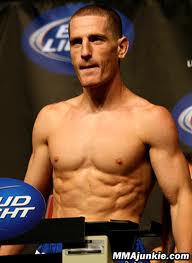
This is Mac Danzig.  Call him a "vegan" when you mean "pussy" and see what happens.


[i] Most of the studies that link eating disorders to vegetarian diets focus on women, primarily young women.  Timko, Hormes, and Chubski’s study considers 486 respondents between the ages of 18 and 25.  Of these, 374 (77 percent) were female, while 111 (23 percent) were male (983).


Work Cited

Timko, C. Alix, Julia M. Hormes, and Janice Chubski.  “Will the Real Vegetarian Please Stand up?: An Investigation of Dietary Restraint and Eating Disorder Symptoms in Vegetarians Versus Non-Vegetarians.”  Appetite 58 (2012): 982-990.  Print.

Wednesday, September 12, 2012

The Vegetarian/Vegan Anorexia Connection


Before I go getting all academic, last week was celebrity vegan week at Plant.  On Tuesday, Carol Adams dropped by for a three hour dinner, and, a week later, I'm still walking around going, "I got to eat dinner with Carol Adams."  She blogged about it here.

 
Carol and me.  I. Am. Happy.

Then on Wednesday, on their way to the DNC, Elizabeth and Dennis Kucinich dropped by for lunch.


I look like crap in this photo, but I attribute that to the fact that I am standing near Elizabeth Kucinich, who is a goddess.  Also pictured: Leslie, Alan, and Jason.

OK, so now to business:

According to historian Joan Jacobs Brumberg’s Fasting Girls: The History of Anorexia Nervosa, “historical, anthropological, and psychological studies suggest that women use appetite as a form of expression more often than men, a tendency confirmed by scholars as well as clinicians” (5), and her work traces the prevalence of so-called disordered eating in women from the phenomenon of anorexia mirabilis that took place in medieval Europe between 1200 and 1500 and during which “many women refused their food and prolonged fasting was considered a female miracle” (Fasting 43) to our present day understanding of the concept of anorexia nervosa as pathologically disordered. What is divinely inspired at one point is disordered at another, and what is obvious, both in Brumberg’s study and elsewhere, is that the concept of ascetic eating – even to the point of starvation – particularly among young women, has a long and complicated history.


 Catherine of Siena (1347-1380), who would be considered bulimic if she lived now.

For Kim Chernin, eating disorders serve as dysfunctional rites of passage for women in a society that does not allow for legitimate and transformative female rites of passage.  As such, the eating disorder is in some sense a misguided feminist attempt to form and then assert a fully realized female subjectivity into a space that does not adequately offer women roles that are distinct from, or not determined by, patriarchy.  Traditionally, rites of passage allow for the uninitiated participant to separate from and then reintegrate with his or her community.  Eating disorders, however, do not allow for reconnection with a clearly defined community that would then lead to the next stage of development, in large part because within Western culture, there are no female communities that are not inherently linked to and dependent upon male culture; women’s culture is, in effect, men’s culture. 

As a result, the “disordered” individual is stuck in time; according to Chernin, “much of the obsessive quality of an eating disorder arises precisely from the fact that food is being asked to serve a transformative function that it cannot carry by itself” (167).  Despite the fact that anorexia nervosa had been “known to physicians as early as the 1870s,” the American press did not start writing about anorexia until the 1980s (Brumberg 11).  And since the 1980s, an increasing body of research has explored the links between vegetarian and vegan diets and disordered eating, noting the possible connections that exist between women’s refusal to eat meat and anorexia nervosa.

In their 1986 study, Rao Kadambari, Simon Gowers, and Arthur Crisp conclude the following:

It can be said that vegetarianism within anorexia nervosa is probably associated with overall dietary restraint within the illness, with mothers who are themselves concerned about their weight, and with a family background wherein there is avoidance of contact with the feared outside world.  These findings invite testable hypotheses within new prospective studies. (544)

Since this study, others have followed.  In their 2000 study “Vegetarianism and Eating Disorders: Partners in Crime?,” Victoria Sullivan and Sadhana Damani assert that their own vegetarianism “never stopped [them from] eating” (265), and that, as vegetarians, they feel protective of that identity and “would like to be able to state categorically that there is no association between vegetarianism and eating disorders” (265).  But even as their study points to some contradictory findings with regard to the connection between eating disorders and a vegetarian diet, they ultimately note that “although the evidence on the whole is limited and contradictory, it does seem that there is at least a passing association between vegetarianism and dietary restraint, and possibly eating disorders” (265).
 
And more recent studies seem to corroborate and expound upon the connections between vegetarianism and anorexia, particularly within adolescent anorectics.  In his 2011 study Some we Love, Some we Hate, Some we Eat: Why it’s so Hard to Think Straight about Animals, Hal Herzog quotes a former vegetarian anorectic named “Staci” who notes that as a teenager, “being a vegetarian was a way for me to have more control over my body by taking the fat out of my diet,” and she notes as well that vegetarianism appealed to her because of its “righteousness:” “at that age, you want to have something that is strong and clear and righteous” (197). 


Finally, speaking of a 2012 study in the Journal of the Academy of Nutrition and Dietetics, Melissa Jeltsen notes that, while this research does not argue that being vegetarian causes eating disorders or that being vegetarian is unhealthy, “it suggests vegetarianism can be a symptom of an eating disorder for some women,” given the fact that of women with histories of eating disorders, “68 percent said there was a relationship between the two,” and the researchers found “that 52 percent of women with a history of eating disorders had been vegetarian at some point in their lives” (Jeltsen). 

In all honesty, I find it completely unsurprising that vegetarianism and adolescent female anorexia are in some instances linked, even for reasons other than the fact that adolescent girls may very well lie about being vegetarian in order to abstain from eating.  But speaking of lying about behavior, adolescents lie all the time in order to hide subversive, counter-cultural, and dangerous behaviors from adults; anorexic teenagers are only one such example. 

Consider another.  First, if a person lies about being vegetarian – for whatever reason, whether to mask an eating disorder or to impress one’s girlfriend who is a vegetarian – but eats meat (is a carnivore) or does not eat anything at all (is an anorectic), one is not really a vegetarian; one is lying. End of story.  If someone lies about going to church as a cover for going to buy drugs, that lie could ostensibly happen for the same reasons: to mask an addiction (which anorexia is as well) or to impress one’s church-going girlfriend, but there do not appear to be any studies linking going to church to drug use (when the drug user is not, in fact, really going to church), while there are studies that continually link vegetarianism to eating disorders, even when the anorectic is not a vegetarian. 


I believe that these studies continue to proliferate because vegetarianism is represented within them via the same rhetoric of pathology that is used to describe anorexia and because female vegetarianism constitutes a choice that offers both a challenge to patriarchy and to a dietary norm dependent upon that patriarchy.  And, finally, because for young women, both anorexia and vegetarianism may be indicative, as Brumberg asserts about anorexia, of mentalities in transition” (Fasting 99); both are unrealized identity formations called upon to allow adolescent women to participate in rites of passage into a full adult female community that simply does not exist.

In all of this research, I have been able to find a singular study that challenges the abundance of others out there linking vegetarianism to anorexia.  B. Fisak’s 2006 “Challenging Previous Conceptions of Vegetarianism and Eating Disorders” does something that the other studies do not do: it examines the motives for vegetarianism and discovers, unsurprisingly, that vegetarians “tend to avoid animal products for ethical and health reasons rather than as an excuse or cover for dietary restraint” (199). The authors conclude that prior studies have argued that vegetarianism “may be an attempt to mask disordered eating” while their “study expanded upon prior research by making a variety of comparisons with psychometrically sound measures of eating disorders” to discover that “in contrast to previous findings, Vs and NVs [non-vegetarians] did not differ significantly on any eating disturbance measures” (198).  


To return to the concept of the ineffective rite of passage as it relates to both anorexia and vegetarianism, I want to posit an assertion that works to further differentiate vegetarianism from veganism, as I feel that one is not simply the more “severe” form of the other, even as, in these studies, if veganism factors in at all, it is as a "severe" form of vegetarianism (as per Rao et al).  By the way, this is a hypothesis, so don't kill me for making it.  


Terrible comic relief.  But you've got to be sick of reading by now.

For some young women caught shuttling between vegetarianism and anorexia, caught in a space that seems to support the perpetual linkage between the two, veganism may very well function as the culmination of a successful, feminist rite of passage, an identity category that allows food to serve the transformative function that anorexia unsuccessfully asks it to serve.  Because veganism may very well be less about dietary restriction and more about an anti-speciesist ethic, a shift from vegetarianism to veganism might allow for productive growth -- at least for some women. 

I know that in my case, at least, that was the scenario.  My vegetarianism was very much tied up with the eating disorder that fully manifested itself by the time I was 19, but I think that for women who find themselves in such circumstances, the connections between these two things – vegetarianism and eating disorders – are much more complicated than simply one serving as an excuse for the other. Without going into great detail about what solidified my decision to become vegetarian, not eating meat made sense to me, and I was not eating meat for ethical reasons; I have never doubted that reality, and I was not lying about the ethical commitment that made me decide to become vegetarian, even as my eating disorder thrived in tandem with my vegetarianism.  One was not a mask for the other, nor was one responsible for the other. 

At the time that I became vegetarian, I had not really cared about what was good for me; I just knew that I did not want to eat animals.  Years later, when I became vegan, I made a conscious choice to eat more fully and to eat better, to consume things that would make me healthy and strong, to eat food that was fresh, whole, and not processed.  The goal was as much one of self-empowerment as animal liberation – and because the connections between those two things were now clear to me, I was able to be empowered by this choice.  Becoming vegan, in its most feminist manifestation, meant doing something actively in response to a cultural stasis that dictated dietary behavior with which I simply did not agree.  I just had to figure out why I did not agree with it.  This time around, I was reacting in ways that felt fully conscious, and that consciousness has allowed me to eat – and live – more and better than I ever did before.

Including animal rights in the discussion about why women choose to become vegetarian or vegan certainly will not alleviate the negative discourse about veganism that pervades both the mainstream media and scientific studies of the links between non-normative diet and eating disorders, but it would certainly allow for more honest analysis, and it might empower instead of pathologize such a choice as having less to do with restricting female diet and more to do with making productive connections between health, feminism, and animal welfare.

If you have a narrative about veganism and eating disorders that runs counter to the various studies that continue to perpetuate linkages between vegetarian and vegan diets and anorexia, I would like to hear it – and with your permission, possibly use it in my own study.  Please send me your stories in 1000 words or less at lwright@email.wcu.edu or post them below.  And thanks in advance.


Works Cited

Brumberg, Joan Jacobs. Fasting Girls: The History of Anorexia Nervosa.  New York: Vintage, 2000.  Print.


Chernin, Kim.  The Hungry Self.  New York: Harper and Row, 1985.  Print.


Fisak, B. et al.  “Challenging Previous Conceptions of Vegetarianism and Eating Disorders.”  Eating and Weight Disorders: Studies in Anorexia, Bulimia and Obesity 11.4 (2006): 195-201.  Print.

Herzog, Hal.  Some we Love, Some we Hate, Some we Eat:  Why it’s so Hard to Think Straight about Animals.  New York: Harper, 2011.  Print.

Kadambari, Rao, Simon Gowers, and Arthur Crisp.  “Some Correlates of Vegetarianism in Anorexia Nervosa.”  International Journal of Eating Disorders 5.3 (1986): 539-544.  Print.

Sullivan, Victoria and Sadhana Damani.  “Vegetarianism and Eating Disorders – Partners in Crime?”  European Eating Disorders Review 8.4 (2000): 263-266.  Print.