Pages

Sunday, February 27, 2011

Vegan and Vegetarian Vampires

My sis Leeann came over for dinner last night (tacos with seitan chorizo, black beans, avocado, and Dayia…yummish) and she, Jason, and I ended up flipping through channels whilst noshing on the comestibles. We landed, for reasons I may never know, on Twilight, and then Leeann and I essentially made fun of Robert Pattinson’s forced smolder (I can just imagine the director, off camera, constantly saying, “smolder more, eh, Rob?”) and Kristen Stewart’s atrociously bad sense of gloomy ennui. Jason, however, actually likes the Twilight movies, and I find this quality, in a straight, 39-year-old man, both perplexing and somewhat adorable. So he watched while we snarked.

This is Edward in a typical pose.

Watching and snarking at Twilight made me aware, yet again, of the current discourse that exists with regard to vampires and vegetarianism/veganism. Edward and his ilk consider themselves vegetarians. He states, in a moment that has received much attention in the veg press and blogosphere, that “We call ourselves vegetarians because we don’t drink human blood. But it’s kind of like a person surviving only on tofu: you’re never really satisfied.” The good and sparkly, out during the day, graduating from high school over and over again vampires of Forks drink only animal blood; they refrain from their baser desires to feed on human flesh. And because they drink animal blood – which, like tofu, never truly satisfies – they consider themselves vegetarians. Aside from this total diss of tofu, which, as the author of Dawnofanewera maintains in her criticism of Edward’s logic, “is the liquid metal of all foods – it can shape shift into just about any meal, as soy can take on many forms, tastes, and textures,” equating eating animals with vegetarianism is just plain wrong.

I must digress for a moment to say that I tried to read Stephanie Meyer’s books; I made it through the first two. And then I couldn’t take it anymore. The things that upset me the most about this series are, I think, the things that upset most women who believe that their existence constitutes more than window dressing. I tend to concur with various critics who claim that the series promotes a not so implicit valorization of abuse (he leaves, he comes back, he lies, he causes her much emotional and physical pain), that it works to undermine female agency and independence (Bella is always rescued by Edward, Bella is always put in harm’s way by him as well, and she continually enables this scenario to remain manifest), and that it reinforces dangerous and, I’d like to believe outdated, Victorian era notions of male and female sexuality: he’s a beast who must learn to control his baser lusts, and she, simply by virtue of the fact that she’s female, is responsible for inciting those lusts. And despite the fact that Bella wants sex, he just can’t defile her (t’would be so wrong), unless they get married.

Twilight makes me miss Joss Whedon’s Buffy the Vampire Slayer all the more.  Buffy is a badass, ass-kicking vampire slayer who fucked her way through a slew of guys, living and undead alike.  And while Whedon’s Angel might remind me a bit of Edward (or perhaps I should say that Meyer has created in Edward a wussier version of Angel – after Angel and Buffy have sex, Angel goes all kinds of psycho), Buffy and Angel finally call it quits, realizing that not being able to copulate is simply not any fun.  Better she should hook up with Spike, which is, incidentally, what I would have done as soon as he entered the picture. Angel who?

Brown chicken, brown cow, brown chicken, brown cow


To Edward’s question of Bella at the end of Twilight, “Is it not enough, just to have a long and happy life with me?” rather than get “turned” (either into a vampire or, er, “on”), Buffy would say a definitive no.  And I love that about her.  But back to the vegetarian issues that the film raises – and that are raised in our current vampire lore, including Buffy the Vampire Slayer, the Twilight franchise, and Alan Ball’s HBO series True Blood

Like Twilight, True Blood also plays with the vegetarian vampire theme, but it does so without ever explicitly stating that theme.  Bill Compton, another of the many non-human eating vamps that lately populate the fictional landscape, is the only real vegan vampire of the Edward, Angel, and Bill troika; he drinks synthetic “True Blood,” a beverage that consists of neither human nor animal blood.  There’s a slew of media out there about the vegan and vegetarian implications of the show, so I won’t bother to post all of that discussion here.
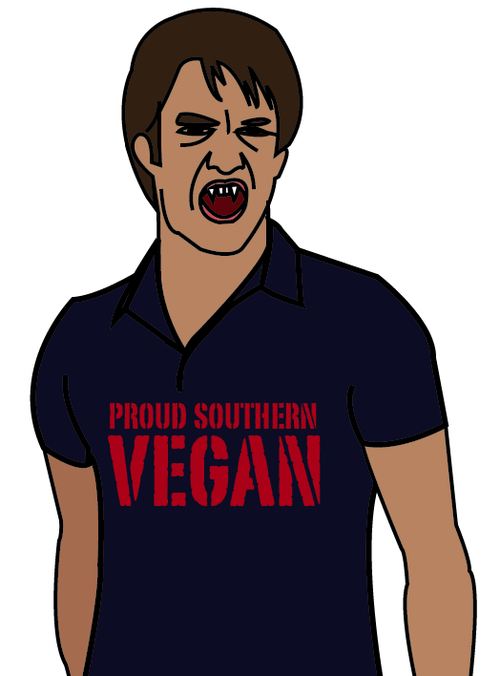
I will, however, post this awesome cartoon of Bill Compton.
 
In terms of this aforementioned troika, all the vampires in question are male, and their decision not to consume human blood is directly linked to their virility, their (in)ability to engage in sexual relationships with women – who very clearly function as consumable objects.  As one of Bella’s friends tells her soon after she starts dating Edward, “he looks at you like you’re something to eat.”  Edward, who doesn’t drink human blood, can’t lose control sexually with Bella.  And he says so every chance he gets.  Eating animals = not having sex, both here and in Buffy and Angel.  When the “vegetarian” Angel has sex with anyone, bad things happen.   

Seriously.

Even Bill, the most sexually functional of the three (he and Sookie boff regularly and often on the show), nearly kills Sookie after losing too much blood.  She gives him her blood, and it’s overwhelming; he can’t stop himself and drinks too much.   


Buffy never actively played with the linkages between non-human blood drinkers and vegetarians.  I always wanted the show to do more with that, but except for a couple of nods in that direction, specifically one episode in which humans are factory farmed and another in which Buffy works at a burger joint (the Doublemeat Palace) and speculates that the “secret ingredient” may be human meat only to discover that it’s cellulous, the show just didn’t go there.  But that’s certainly preferable, I think, to Twilight’s aligning of vegetarianism with the very antithesis of vegetarianism – eating animals.  Despite the fact that PETA2 gave the movie a Libby award for being the most animal friendly film of 2008 (largely because, despite the fact that Stephanie Meyer’s Bella isn’t vegetarian, Kristen Stewart, who is a real life vegetarian, plays Bella as veg in the film), the movie still places the killing and consumption of animals at the fore of its narrative.  And all of these recent reinventions of vampire lore still maintain the same sexual politics of blood that underscore older versions of the story, only now those politics include a tacit discourse of non-human blood as well.

As my sister astutely noted, as we snarked at Edward, “just because you’re not a cannibal doesn’t mean that you’re a vegetarian.” I’m so making a tee shirt that features Edward Cullen’s face and that statement.  Wait for it.

Sunday, February 20, 2011

Valentines and Vegans

The last month has been a blur, and I need things to slow down.  First, the state of North Carolina’s budget situation vacillates between terrifying and out-and-out catatonia producing, so my mind and my energy has been devoted to fighting that (most likely meaningless) fight.  I desperately want to turn my energy back to my teaching and my scholarship, the things about my job that I like, but I keep getting drawn into the discourse of trying to justify my existence.  Have you seen this video?  


It has nothing to do with veganism, but it is so true.  And, at present, that female professor is the embodiment of me.*  But next week is spring break, and if I can just make it until then, I might survive.

* This is not to say that I haven’t also been the little blonde girl with the pigtails.

So let me pull myself out of the mire of the possible dismantling of the public education system as I know it and return to the world of the vegan blog.  Valentine’s Day was pretty swell.  Jason didn’t get me anything as usual, but what’s not usual is that I went into major preemptive bitch mode about the fact that I knew he wasn’t going to get me anything.  I have a friend who calls such behavior “pre-suffering,” and I think that’s about right.  I was, after 13 years of being in a relationship with this boy, suddenly made jealous about the fact that a colleague was discussing the Pajama Gram that he was sending his sweetie.  First of all, I didn’t want a Pajama Gram, not even this one, which would make me look like a giant piece of bubble gum.

But I suddenly wanted something.  What I got was a Valentine’s Day without Jason, as he was at work all freaking day and night, fixing a Valentine’s Day vegan dinner, which I did get to eat for free.  It consisted of the following: first, sweet potato soup with scallion cream cheese and a candied basil leaf; second, chili rubbed seitan and grilled broccolini with smoked Jerusalem artichokes over a savory apple sauce; and for dessert, cocoa risotto beneath coconut tempura banana with a side of Kahlua ice cream.  And it was excellent.  So Jason is forgiven.  He does this every year, and every year the meal is better than the previous one.

Today’s news contains the following top five items when one does a news search for “vegan”:  an article called “What Would Vegan Society Founder Donald Watson Think” about a debate in the UK as to whether animal rights activists should tone down their focus on veganism and speciesism as these stances tend to alienate non-vegans. The author, Gary L. Francione, write about an ad in a Vegan Society publication for a bed and breakfast that serves the likes of poached eggs and Danish with cheese.  He states that Watson, who died in 2005, “coined the word ‘vegan’ and founded the Vegan Society in 1944 precisely because he wanted to emphasize that not eating meat was not enough. He wanted to erase the arbitrary line that had meat on one side and everything else on the other.” He quotes Watson:


The excuse that it is not necessary to kill in order to obtain dairy produce is untenable for those with a knowledge of livestock farming methods and of the competition which even humanitarian farmers must face if they are to remain in business.

For years many of us accepted, as lacto-vegetarians, that the flesh-food industry and the dairy produce industry were related, and that in some ways they subsidized one another. We accepted, therefore, that the case on ethical grounds for the disuse of these foods was exceptionally strong, and we hoped that sooner or later a crisis in our conscience would set us free.

That freedom has now come to us. Having followed a diet free from all animal food for periods varying from a few weeks in some cases, to many years in others, we believe our ideas and experiences are sufficiently matured to be recorded. The unquestionable cruelty associated with the production of dairy produce has made it clear that lacto-vegetarianism is but a half-way house between flesh-eating and a truly humane, civilized diet, and we think, therefore, that during our life on earth we should try to evolve sufficiently to make the ‘full journey’.

A second story, a self-proclaimed “rant” by “veggie girl,” is an “Open Letter to Militant Vegans,” in which she asks militant vegans to “shut the fuck up already.”  Veggie Girl is, as she states, “on your side,” but she ultimately states that

I'm tired of being lumped in with your ilk. My choices are just that -- MINE -- and I respect the rights of others to make their own choices, whether they're vegan, vegetarian, a conscious meat-eater or stop by the drive-through every night. Get off your high horse, shelve the self-righteousness and lead by example. THAT is how you change eating habits -- and lives. Otherwise, you're just an animal-loving version of Fred Phelps. And nobody likes that guy except his fellow church members. And maybe not even them.

So both of these pieces bring into relief the perceived vegan persona, legitimate or not, as alienating and off-putting, as needing to be tempered, as needing to be modified to prevent making the general public from feeling put upon or threatened.  While Veggie Girl does make the claim, however unsubstantiated, between militant and non-militant vegans, the narrative that Veggie Girl and Francione evoke is one that, while they argue from opposing positions, is illustrative of the strange stance that vegans seem forced to occupy, as ethically guided by a belief that animal suffering is preventable and unacceptable yet somehow responsible for the comfort levels of those who disagree.

Other stories: Jessica Simpson is maintaining a vegan diet to lose weight prior to getting married 
And Ryan Couture, some kind of fighter guy, won a fight.  He’s a Los Vegan, which is nothing like being a vegan, but that’s why this story came up.  File that one under who fucking cares…

Monday, January 31, 2011

Veganorxia: A Term that I Thought I Coined, but Didn’t (damn it)

Well, first off, I think it goes without saying at this point that the extent of my scholarship for this semester will consist of this blog.  I’ve had two conference papers accepted, one at ASLE, an extremely selective venue, and the other at NEMLA.  And I haven’t written either paper.  I did, however, submit a review of someone else’s book (Monica Popescu’s impressive South African Literature After the Cold War) to Safundi, and I’ve been asked for a book cover blurb for a collection of essays on J. M. Coetzee, so I guess that’s something.  But all I seem to be doing is reading other people’s work, which is great, and other people’s program prioritization reports, which isn’t. 

But let’s not talk about me and my university service woes.  Let’s talk about veganorexia.

OK, so a couple of entries ago, I was sort of kidding when I said that my next entry would be on veganorexia and Natalie Portman’s portrayal of an uber-eating disordered ballerina in Black Swan (the first meal that she eats is half a grapefruit and boiled egg.  Of the grapefruit, she claims, “it’s so pink and pretty”).

Nothing vaginal there.

I was thinking of Portman, who is vegan as a result, she claims, of having read Jonathan Safron Foer’s Eating Animals.  As she notes, “what Foer most bravely details is how eating animal pollutes not only our backyards, but also our beliefs. He reminds us that our food is symbolic of what we believe in, and that eating is how we demonstrate to ourselves and to others our beliefs.”   

There has been much in the media about the rigors of both actual ballet training and what Portman put her body through in order to achieve the elongated and sinewy female form that we observe, via an extremely male-oriented gaze, in Aronofsky’s film.*  Victoria Looseleaf has written an essay on the ways that Black Swan fetishizes not only the anorexic body but also enforces various other forms of body fascism.  So there’s ample information out there for me to make a kind of joke of Portman’s vegan constructed balletic anorexia.

This photo says it all, don't you think?

Back to veganorexia, a term that I thought I’d coined.  But a search for the term pulls up all kinds of things, including an entry in the Urban Dictionary: a veganorexic is “A person with Anorexia who denies or hides it by saying he/she is Vegan.” And there is a perverse and performative vegan presence on various pro-ana web pages (note: possibly disturbing material), a call to women who want to get super skinny to become vegetarian or vegan.  Even Rory Freedman and Kim Barnouin’s Skinny Bitch, a book that I grudgingly admire, is, as Julie Klausner claims, “a PETA pamphlet in chick-lit clothing and an innovative fusion of animal rights activism with punitive dieting tactics that prey on women's insecurities about their bodies.” 

The links between vegetarianism and veganism and anorexia are real in ways that are all too familiar to me, primarily because becoming vegan was, for me, part of a long process of overcoming a history of anorexia and bulimia, eating disordered behaviors that are defined by the willing denial of food.  Far more often, I fear, veganism or vegetarianism and used as the excuse for this denial; in my case, veganism was the excuse that I needed to get over it, to eat, to empower myself to react to cultural dietary proscriptions over which I had historically had no control. And, again for me, the gender implications of becoming vegan were profound and empowering.  I wish that could be the case for everyone.

But more on that later.  

* I really hated Black Swan.  Sorry.  But this is pretty funny:

Monday, January 24, 2011

The Vegan Brain

So things just got really busy: the North Carolina budget is a disaster; the University of North Carolina system is seriously affected by this reality; the university where I work is looking at ways to cut 15% (somewhere around $15 million) from its operating costs for the 2011-2012 year.  As a result, all programs at my university must generate “program prioritization reports” to justify keeping the program (as opposed to seeing it axed).  I had to write two of these things for two programs that I direct, so I’ve been busy; a lot goes into fighting for one’s job and the jobs of one’s colleagues.
 
And now we’ll all just wait for the proverbial ax to fall where it may.

But in the midst of all this – the panic, depression, and overwhelming certainty that no matter how much time and effort I put into these reports, no matter how much data I provide to demonstrate the mission critical nature of my programs, the quality of the faculty who teach in them, or their cost effectiveness, the administration will do what the administration has, most likely, already decided to do – a bit of vegan goodness came my way.  So I’ll share.

A friend sent me an article about the differences between brain activity between omnivores, vegetarians, and vegans in response to images of human and nonhuman suffering.  Here’s the abstract:

Empathy and affective appraisals for conspecifics are among the hallmarks of social interaction. Using functional MRI, we hypothesized that vegetarians and vegans, who made their feeding choice for ethical reasons, might show brain responses to conditions of suffering involving humans or animals different from omnivores. We recruited 20 omnivore subjects, 19 vegetarians, and 21 vegans. The groups were matched for sex and age. Brain activation was investigated using fMRI and an event-related design during observation of negative affective pictures of human beings and animals (showing mutilations, murdered people, human/animal threat, tortures, wounds, etc.). Participants saw negative-valence scenes related to humans and animals, alternating with natural landscapes. During human negative valence scenes, compared with omnivores, vegetarians and vegans had an increased recruitment of the anterior cingulate cortex (ACC) and inferior frontal gyrus (IFG). More critically, during animal negative valence scenes, they had decreased amygdala activation and increased activation of the lingual gyri, the left cuneus, the posterior cingulate cortex and several areas mainly located in the frontal lobes, including the ACC, the IFG and the middle frontal gyrus. Nonetheless, also substantial differences between vegetarians and vegans have been found responding to negative scenes. Vegetarians showed a selective recruitment of the right inferior parietal lobule during human negative scenes, and a prevailing activation of the ACC during animal negative scenes. Conversely, during animal negative scenes an increased activation of the inferior prefrontal cortex was observed in vegans. These results suggest that empathy toward non conspecifics has different neural representation among individuals with different feeding habits, perhaps reflecting different motivational factors and beliefs.

Mostly I read this and think: “do what, now?”  I don’t know what a “conspecific” is, nor do I fully comprehend the nature of “increased activation of the lingual gyri.”  But what I’m taking away from this – and what I didn’t really need a convoluted scientific study to tell me – is that people who make dietary choices based on ethics that are opposed to human and nonhuman suffering process images of suffering in ways that are different from people whose diets don’t reflect these considerations.  The fact that brain functions differ between these groups seems like a big old “duh” to me.

 (a wee can of duh)

But – and mind you, I’ve only read the abstract and glanced at the charts (I was like, pictures!) – this kind of research tends to show me nothing.  What do we make of the differences in the way various vegan, vegetarian, and omnivorous brains process suffering?  Does the brain response follow from the ethics behind the dietary choice, or do the ethics arise from a brain that is biologically hard wired differently from the majority?  Ultimately, I’m not sure that finding a definitive answer to these questions really matters.

But I’ll try to make it through the full piece and let you know if I learn anything useful, like, for example, how to make everybody's brain work like a vegan brain. . . but I'm doubting that that information is there.


Sunday, January 16, 2011

Alicia Silverstone is pregnant.


So read a news headline in the Asheville Citizen-Times yesterday, which is weird, because, well, why the Asheville paper?  I sort of ignored the story, because I really don’t care about celebrities (or really anyone else, for that matter) having babies, nor do I really care all that much about Alicia Silverstone, except that she’s vegan.  Here’s her blog on the subject. 

I’ve thought about this a bit: the fact that if a celebrity is vegan, I will feel a sense of connectedness to that celebrity, but that connection to a vegan community, like all other imagined communities is, well, imaginary.  I guess that veganism is a pretty important thing to have in common.  It implies a kind of shared ethic, a shared set of ideological underpinnings – at least in theory.  But then I realize that part of my project with this project (blog and book) is to demonstrate that the very notion of a homogenous vegan identity is a fiction.

Still.  What’s the first thing that I do when I start to like an actor or musician?  Check to see whether or not that person is vegan.  It’s easy to do this, but there is sometimes conflicting information (is, for example, Mike Tyson really vegan?).  Websites like Happy Cow and Famous Vegans have lists of every vegan celeb imaginable.

When I was in New York week before last, I passed Parker Posey in the dog park at Washington Square Park. 
(seriously, that's her and the dog.  Photo taken by Jason)

OK, she has a dog that she takes to the dog park, so I already love her.  Love her anyway (have you seen House of Yes?).  When we got back to the hotel, I searched to see if Parker’s a vegan.  She’s not, at least her name doesn’t appear in any list I can find. 

And this being a vegan or not being a vegan is certainly not the deciding factor in terms of whether or not I like a celebrity or his or her art, but it’s still something that matters enough for me to search for it, to feel a common bond if I find it -- which I realize is perhaps ridiculous. 

But back to Alicia Silverstone and her pregnancy: Alicia’s body has been an object of intense scrutiny since she starred in Clueless back in 1995.  Her role in that film won her much critical acclaim, and the media positioned her as the next big thing.  And then she starred as Batfgirl in Batman and Robin (1997), which flopped.  And then suddenly there was all this press about how she had gotten fat. She gave up meat and all other things animal over a decade ago; the weight dropped, and she wrote a cookbook called The Kind Diet

Alicia Silverstone’s body and her bodily decisions have always been in the media, have either been praised of maligned, from the time she was the hot young thing in all those early 90s Aerosmith videos, to her Catholic schoolgirl turn in Clueless, to the skin-tight rubber suit wearing Batgirl.  Her veganism is closely tied to her animal activism, something that she has always been outspoken about, but her veganism is also the key to the weight loss that allowed her to be deemed sexy once again.  In fact, she was filmed by David Meyer in a naked testimonial for PETA in which her voiceover extols the virtues of being veggie while she slips naked from a pool and basically licks the camera. 

In her case, her veganism has allowed for her bodily ascension, or perhaps re-entry, into the cult of Hollywood beauty.  And in allowing herself to be videotaped naked for PETA, she demonstrates a failure to connect the objectification of animals via our consumption of them, to the objectification of women via our scrutiny and fixation on their bodies.  In this video, Silverstone is consumable object, panning to the very internalized male gaze that perpetuates her need to drop the pounds, and the very real and pervasive masculinist ideology that very often undermines her dietary and ethical choices.

It will be interesting to see how the media and Silvestone herself treat her pregnancy; it will be telling to see how much she has to justify in terms of her diet as she carries her child to term. 

Next time, veganorexia: Natalie Portman and Black Swan.  Oh, and Jason loooooves Alicia Silverstone.  When I told him that she was pregnant, he sighed and said, “sadly, it isn’t mine.”  

Thursday, January 13, 2011

These guys

I work in the rural backwater of Western North Carolina.  And this is generally a good thing, except for days when I find two dogs on the side of Highway 74 on my way to work on my FIRST DAY OF CLASS FOR THE SEMESTER (in single digit weather, in the snow, dogs without tags, without microchips, without any discernible way for me to tell from whence they came, most likely because they were dumped -- maybe dumped in the hope that someone like me would pick them up and take them in).

Freaking ruined my first day back, by the way.  I'm just glad that I have good friends who let me stow said dogs in their basement while I taught (and I'm so glad that I have tenure. Otherwise, my performance in my class, compromised by the fact that my mind was on the displaced dogs, might have profound implications for my career).  Now the dogs are in my home office, 40 miles or so from where I found them (I work 50 miles from my house, and my journey takes me through the mountain wilds of North Carolina.  It's a beautiful drive, except on days like today, when the drive is tainted...and this isn't the first time I've picked up animals along this route).

I'm one of those people who finds dogs and cats, which is to say that I am one of the ones who stops when I see them.  I'm one of the ones who takes them in, one of the ones who keeps them and finds homes for them.  I'm not chosen; I'm not someone special, and I'm certainly not someone who believes that it's my destiny to find stray and abandoned animals.  But I am someone who notices them.  And while many people might see them as they wind along the highway, most people don't stop to take them in.  So in this sense, I'm special.  Or whatever.  But I shouldn't be.

Dogs constitute one component of our minion biota, a species that we, homo sapiens, continue to perpetuate, even as we decimate numerous other species by virtue of our environmentally destructive, overly consumptive excesses.  Dogs are in the company of our other minion biota, cats, for example, as well the species that we consume: pigs, chickens, and cows.  These species survive because we allow them to survive, because we need them in some way -- either as consumable objects or companions.  But in both contexts, they exist at our whim; dogs and cats are still "other," creatures that we can abandon if we need or even want, if they get sick, if housing them is inconvenient.  Cows, chickens, and pigs are food, manufactured for consumption, not to live a life during which they might experience happiness, comfort, or even companionship.

I have these abandoned dogs, now, and I'll find a place for them, as I've done for many others.  And my feelings for them are not sentimental.  These dogs (chickens, pigs, cows) should have the same right to a life without suffering that I have.  So I'll do whatever I can to ensure that they get it.

Wednesday, January 12, 2011

No Vegetarian/Vegan series on Food Network of Cooking Channel

On January 2, I accidentally caught the tail end of a show on the Cooking Channel called “Veg Edge,” which was being hosted by Isa Chandra Moskowitz.  The show was unlike anything that I’d ever seen on either the Cooking Channel or Food Network, as it was focused on vegan chefs and restaurants.  As far as I can tell – and after numerous emails to both networks suggesting that they consider it – there had never been a weekly vegetarian, much less vegan, cooking show on either network, so it was a pleasant surprise to see this one; not only was it focused on vegan food, restaurants, and lifestyles, but also because the people and places featured were the tough face of veganism, the hardcore, heavy metal, badass variety of vegan.  The show offered a kind of response to the view of vegans as tree hugging, weak, and feminized.  Of course, these two views constitute a kind of binary that seems present in the popular cultural discourse surrounding veganism – vegans as members of an anarchistic, post-punk subculture that is subversive, or vegans as ascetics, dietary minimalists, pale and ineffectual in their misplaced zeal.

Interestingly, this binary is also very gendered: the “Veg Edge” show featured both men and women, but the show did much in terms of generating a view of veganism that is highly masculinized, a version of veganism that presents a counter-discourse to the view of human herbivores as feminine or emasculated, particularly in U.S. culture where meat is presented and sold as masculine

But anyway.  I bring this up because of Jason.

I’ll go ahead and say that I’m completely biased about Jason, because I’m sort of married to him (and here's an interview with him), but the “Veg Edge” special made me angry (for about the 700th time), that Jason doesn’t have his own show on the Food Network or Food Channel.  So I wrote to Isa Chandra Moskowitz, thanking her for hosting the “Veg Edge” show and telling her about Jason, “the salad-eating vegan who can put you through a wall,” as a possible guest for the series.  And she wrote me back…to let me know that the show was a one time special. 

I feel pretty certain that at some point, there will be a mainstream vegetarian show on one or the other of these networks, but it hasn’t happened yet.  The closest that they’ve come is the “Veg Edge” special and an episode of Food Network’s “Top Chef Masters” during which five famous carnivorous chefs made a vegan, gluten free, soy-free lunch for Zooey Deschanel  – an event that sent good ole boy Art Smith into such a frenzy that he served a desert of Rice Dream and strawberry jam…which got him axed from the show.  The Top Chef episode revealed just how difficult it is to make delicious food, if you don’t know how to do anything other than meat, butter, and cheese.  It showed that vegan cooking requires a level of creativity – or perhaps just a different kind of creativity – that is not accessible to more classically trained chefs.

Here’s an episode of Yvonne Smith’s* “The Traveling Vegetarian” that features The Laughing Seed and Jason.

Now get off your butt and write to the Food Network and demand a vegan cooking show!


* Yvonne Smith has 3876 friends at present, which I find amazing.  At last count, I have 326, which seems impressive, until you are friended by someone with 3876 friends.