Pages

Thursday, June 30, 2011

ASLE, Animals, Contextual Moral Vegetarianism, and Me


Part 2: Things go Dark and Creepy

Now that I’ve ruminated about all the productive and positive things that happened at ASLE, here’s a bit about what I presented: an essay on the role of contextual moral vegetarianism in Yann Martel’s novel Life of Pi. To be clear (again), ASLE is about literature and representations of the environment in literature, but, perhaps, because I have had limited experience in the real world, literature functions for me as a way of accessing the real world, and this is one of the main themes that I incorporate in my teaching: that nothing one reads in a fictional work of literature is any less true than what one reads about and learns in a history class.  As Nobel Prize winning South African author Nadine Gordimer states in “Living in the Interregnum,” her 1981 James Lecture presented at the Institute for the Humanities, “nothing I say here will be as true as my fiction.”

In Life of Pi, the title character is an ethical vegetarian…until he’s stranded for 227 days on a lifeboat, adrift in the Atlantic Ocean, his sole companion a Bengal tiger named Richard Parker. In terms of my essay, it’s largely based on a bit of theoretical shifting that is a part of the realization that being vegan/vegetarian makes no sense in certain contextual situations (duh, right?).  What is one to do, for example, on a lifeboat in the middle of an ocean?  Such a scenario is the extreme case, but Pi’s ability to contextualize his diet, to partake of sea creatures (and possibly even to partake of the flesh of another human) situates vegetarianism and veganism as dietary choices that can only be made in certain (privileged) circumstances.
 
Here’s the start of the essay:
Perhaps nowhere is the conflicting nature of the Western rhetoric of species preservation more apparent than in much of the current debate surrounding vegetarianism.  In conjunction with the twentieth and twenty-first century Holocene extinction spasm has occurred the rise and commercialization of a vegetarian diet as an ethical imperative and as a presumed reaction to and proposed remedy for environmental destruction – including species decimation.  Arguments in favor of such an ideology often cite, among other factors, the environmental damage done by factory farms and the depletion of arable land as a result of overgrazing.  Despite Anthony Bourdain’s limited claim that "vegetarians, and their Hezbollah-like splinter faction, the vegans ... are the enemy of everything good and decent in the human spirit,” arguments in favor of a vegetarian diet focus on a politics of compassionate consumption, the health benefits of eschewing meat, and the positive environmental impact to which such a diet contributes.  Bruce Friedrich offers one such argument: the amount of land used to satisfy the food requirements of a vegan for one year is 1/16 acre; for a meat eater, the figure is 20 times as high.  Similarly, “it requires 300 gallons of water to feed a vegan for a day.  It requires about four times as much to feed a vegetarian, and 14 times as much to feed a meat eater.”

OK, all well and good.  But despite such statistics, vegetarians are the “enemy” and vegans are “Hezbollah.” (by the way, that’s the worst analogy ever in the history of faulty analogies.  Seriously: hez·bol·lah [Arab. khes-bah-lah]–noun a radical Shiʿite Muslim organization in Lebanon engaged in guerrilla warfare against Israel. veg·an [vej-uhn; especially Brit. vee-guhn]–noun a vegetarian who omits all animal products from the diet).  So, if this is the general perception (and I kinda think that it is), how do we crazy animal rights people convince the rest of the world that being veg matters or is helpful (or is healthful or that being compassionate to animals – the ones that aren’t pets – is necessary)?
 
Intermission.  Consider Scott Adam’s assessment in Dilbert for more on the crazy:


Oh, and by the way, a big fat fuck off to Anthony Bourdain, who capitalizes on being a vegan hater.  Anyone can cook with meat; it takes talent to cook without it.

The Ramones tee-shirt notwithstanding, he’s still a dillweed. 

Here’s Deane Curtin on the subject of contextual moral vegetarianism – and Deane Curtin is a major source for my thinking in this essay: In Environmental Ethics for a Postcolonial World, Curtin has claimed that he can imagine saying “to a dominant white culture, which has perfected the global food market and excelled at industrial farming, that we have an obligation to be vegetarian,” but he notes that
as a ‘contextual moral vegetarian,’ I cannot refer to an absolute moral rule that prohibits meat eating under all circumstances. There may be some contexts in which another response is appropriate. Though I am committed to moral vegetarianism, I cannot say that I would never kill an animal for food.

Mostly, I tend to agree with Curtin’s statement that in the West, we white folks have a moral obligation to be veg – and I also recognize the racial implications of such an assertion.  I’d argue a bit differently, that perhaps race may be a part of the contextual picture, but socio-economic status is probably a bigger factor.  Carol Adams deals that the contention that veganism/vegetarianism is a particular form of racism – an argument often posited in order to support the cultural significance of a subordinate (read as “nonwhite”) population’s ancestral and familial connections to a meat eating – by linking the oppression of nonwhite groups to the oppression of animals.  And that’s an argument I get as well – and I’ve written about that idea all over the non-blog world, so I won’t rehash my sentiments here. 

In terms of who should be and who has a contextual right not to be veg, I prefer not to make pronouncements beyond the fact that I’ve never understood the reasons offered by people who have given me (almost always uninvited) their opinions as to why not.

But I also understand the contextual argument, particularly given all kinds of racial, socio-economic, and global circumstances that do not support vegetarianism or, on the more extreme end, veganism.  For example, Curtin goes further to discuss the Makah nation of Washington State; the Nation asserts that it has a right to hunt gray whales, a species that was removed from the Endangered Species List in 1994 (Curtin 137).  For the Makah people, whaling’s cultural significance has become a key aspect of their cultural renaissance.  Despite the United States government’s allocation of 20 gray whales to the Makah over a four-year period, however, animal rights and environmental activists have protested Makah whaling and denounced the practice.

OK: so back to ASLE.  Here’s me trying to discuss this contextual vegetarian ethos, and then there’s this bumper sticker displaying a precise example of such an ethos:


I can’t find any information that links this organization, the Fur Harvesters of North Bay, Ontario, to native peoples, even though the image on the sticker is of a stylized image of a native person, a trapper, disenfranchised by the whites who invaded North America (there are links on Fur Harvesters’ web page for such things as “furisgreen.com” and “Origin Assured," which, while arguing for the green and sustainable nature of fur, convince me of absolutely nothing).  

The image, for whatever it’s worth, capitalizes not only on the concept of context, of native people’s cultural history of hunting and trapping but also on the (false) belief that hunting and trapping is a way of protecting women from harm.  By such logic, if one hunts and kills animals, one is less likely to hunt and prey upon and kill women (little old ladies in this case).  The sexual politics of fur.  What a problematic phrase, in oh so many ways.

But there is much evidence to support a counter-argument, that there are connections between the killing/abuse/hunting of animals and the killing/abuse/hunting of humans – predominantly women and children.  So let’s start with Ed Gein a hunter, who gutted his female victims like deer. 

I get that Gein was batshit cuh-raaz-ee, so perhaps his example is not exactly representative. 

But here’s an article in Newsweek on the subject of the links between animal cruelty and the murder of humans and another from PETA on the connections between animal abuse and domestic violence.  Lastly, CBS News has this 2009 story of a deer hunter who shot and killed six other hunters – one of whom was female. 

Canadian author Margaret Atwood's novel Surfacing makes clear the connections between hunting and trapping animals for fur in Canada and the objectification of women and nonwhite minorities: “‘Do you realize,’ David says, ‘that this country is founded on the bodies of dead animals?  Dead fish, dead seals, and historically dead beavers, the beaver is to this country what the black man is to the United States’” (46).  And later, when the unnamed narrator doesn’t understand David’s joke that “a split beaver” (141) should emblazon Canada’s flag instead of the maple leaf, he responds, “where’ve you been living?  It’s slang for cunt” (141). The narrative that kids who hunt animals grow up not to hurt women or other members of society, well, that’s specious logic at best, no matter what the context.

I’ve written too much and still managed not to say anything about Lauren Spierer, who’s still missing.  And then there’s Crystal Grubb, who isn’t missing anymore. Yep, context – here as well as in matters of vegetarianism/veganism – matters. 


Monday, June 27, 2011

ASLE, Animals, Contextual Moral Vegetarianism, and Me


Part 1:

On Saturday, I flew back from Bloomington, Indiana, where I had presented a paper at the ASLE convention – the Association for the Study of Literature and the Environment.  On the plane beside me sat a Bosnian guy who looked exactly like Morrissey circa 1987; he talked to me about living in the U.S., about his brother who’s still in Bosnia and likes to hunt.  He’d never heard of Morrissey. 


He didn't look like this version of Morrissey, but I freaking love this photo.

But I digress…

ASLE: the focus this year was “Species, Space, and the Imagination of the Global.”

I presented a paper called “The Politics of Eating Postcolonial Animals: Contextual Moral Vegetarianism and Life of Pi,” which is an excerpt from a chapter titled “Safari, Zoo, and Dog Pound: The Place of Animals in the Postcolonial Environment” in my book. 


Yes, I know.  Shameless.  But, hey, buy my book.

OK, so before I go into further details about that presentation, there are things about the conference in general and about my inability to successfully or appropriately participate in an academic conference that need explication.  And, perhaps, I can come to terms with certain aspects of my personality that make me a bad academic, at least in this aspect of my professional life.  First, a bit about ASLE.  This organization has been in existence since the mid-1990s, and is the preeminent scholarly organization for folks who explore environmental issues in literature and, more often than not, in life.  The conference strives to make as small a footprint as possible, implementing such measures as “creating a vegetarian banquet with several interesting menu choices featuring local and/or organic foods as much as possible, including local beers and wines,” and “minimizing décor for the banquet and using artificial, reusable planters, linens, and other reusable décor items.” (This info courtesy of the conference website) 

This year’s conference actually featured two panels about veganism, called “The Vegan Challenge to Posthumanism” (parts 1 and 2), and animal studies in general was a primary focus of much of the work that was presented.  However, despite the seemingly obvious fact that the conference theme indicated a more global focus – and, indeed, there were panels, like mine, that examined the environment from a postcolonial perspective – the “global” was not really a major part of the agenda.  The overarching and traditional discourse of ecocriticism as a theoretical perspective – and ASLE is the entity that codified that discourse into scholarly legitimacy – has been and remains entrenched in American literature written by white (often male) authors, and such was certainly the case this year in Bloomington.

The big names in the field were all there, and, by and large, the big names focus on Western writing.  American literary scholar and godfather of ecocriticism Lawrence Buell was honored for his foundational work (and my friends and co-presenters Colin Christopher and Ali Brox got to eat lunch with him -- and he is, by all accounts, a seriously nice dude), but South African author Zakes Mda was a plenary speaker, as was Helen Tiffin, a prominent postcolonial scholar whose most recent work is Postcolonial Ecocriticism: Literature, Animals, Environment.  And Cheryll Glotfelty, who co-edited the foundational Ecocriticism Reader with Harold Fromm (remember him from an earlier entry?  He’s the guy who, in the Chronicle of Higher Education, trashed vegans) shook my hand: her book was sitting right beside mine on the University of Georgia Press table.  So the paradigm is shifting, albeit slowly.  At the author’s reception, I was situated in a corner near the back of the room (Colin said, “nobody puts Baby in a corner…”), and there was much joking about my marginalization.  But it’s all ok.  It’s fine. 

And good things happened for me, so I’ll toot my own horn for a bit: Byron Caminero-Santangelo, who moderated my panel, introduced me as “the preeminent Coetzee scholar working in the U.S.,” which made me feel really good – even if I’m not sure his assessment is 100% accurate.  Still, it made my day.  People bought my book and asked me to sign it; the University of Georgia Press representative told me that she sold out of it, which may or may not be impressive, as I think she only brought about five copies with her.  But, hey, selling any academic books counts as a success.  And I met people like Dan Wylie and the aforementioned Cheryll Glotfelty as well as a bunch of really cool folks from the University of Kansas and elsewhere.  And a woman approached me after my presentation to tell me that Carol J. Adams had included my video in her famous Sexual Politics of Meat slideshow.

I really liked Bloomington; it’s such a real college town, with all kinds of neat little shops and an overwhelming number of places where a vegan can eat.  I ate at Roots on the Square twice and at a Vietnamese fusion place called Basil Leaf Bistro.  After my presentation, a group of us went to a place called Scotty’s Brewhouse, a sports bar with a menu the size of a short novel, in which there appeared such items as burgers with peanut butter, deep fried pickle chips, and lots and lots of items buried beneath cheese and bacon.  But, of course, there was a veggie burger, so that’s what I had, as did the one other vegan in the bunch.  He and I had been betting on what our options would be, noting that in the case of such places, it’s either a veggie burger or some sort of Portobello concoction. And with the check at the end of the meal, we got little boxes of Red Hots, which, sadly, aren't vegan.  They contain beeswax.  Who knew?

But I am bad at conferences.  And all the good things that happened at this one don't really counter that fact.

I get nervous and weird, afraid to mix and mingle, intimidated by all sorts of things.  And I’ve presented, at this point in my career, at zillions of the damn things.  More often than not, my strategy is to attend my panel and maybe one other and then to hide out in my hotel room the rest of the time.  ASLE was particularly tough on me: this is a conference that started off small but has exploded over the past several years, so in terms of sheer numbers, it’s scary for someone like me who much prefers smaller venues – like the postcolonial studies conference that I attend nearly every year in Savannah, Georgia. 

Despite the fact that I don’t really feel overly intimidated by the academic rock stars that attend and present at these venues, the sheer number of those foundational figures present at this conference gave me pause.  Oh, and the fact that Greg Garrard has groupies – and that I think I might be one – is also problematic.  


Greg Garrard. I know, right?

The concept of “academic rock star” has always seemed both impossible and hilarious to me – we are all English professors or graduate students – but in my limited world, the way that certain of us achieve the role of public intellectual feels very powerful, and it’s both a heady and intimidating experience to encounter such beings.  And we all aspire to be like them.

But perhaps what was more difficult was – and always is for me – the tension that I feel between a lived ethic or a lived activism and a theoretical presentation about how environmental or vegetarian or vegan issues are presented in works of fiction.  And that tension seems to be even more pronounced at a conference like ASLE, which is, at least in theory, all about the environment but which, in reality, is all about talking about fictional representations of the environment. And, more often than not, such talk is of a very specific environment at that, one that is accessible to those of us able to participate in the fiction that what is meant by “environment” is a pristine and untouched wilderness available to us as an object for privileged consumption.

OK, perhaps I’m not being entirely fair.  I’ll say more in part two, about my paper, about contextual moral vegetarianism/veganism, and about Lauren Spierer, a young Indiana University student who has been missing for over three weeks and whose image, on posters, billboards, and fliers was absolutely everywhere in Bloomington.  And I’ll say more about this bumper sticker, seen in a movie theater parking lot:


Yeah, after presenting my paper, I went to see Bad Teacher.  Like I said, I'm bad at conferences. 

Friday, June 3, 2011

Plant and Dracula

Well, I've been away from this blog long enough to have forgotten how to sign in...  The end of the semester nearly killed me (it often does), and I'm just now surfacing from beneath it.  It was the year of service for me: I directed the Graduate Program in English, served on the Liberal Studies task force, the International Studies advisory committee, both the college and university Program Prioritization committees, and was the Secretary of the Faculty, which means that I was also de facto on a bunch of other committees...  And I directed two fabulous MA theses and have been a reader for several more.

I won't be secretary of the faculty next year, so that's a huge obligation lifted.  I hope to be able to start researching and writing again, as I've pretty much taken the whole year off (wrote one book review during 2010-11).  So far, this summer I've written an article on Margaret Atwood's Surfacing -- a piece for which I'm getting paid (!) -- and that's it.  The vegan body project is my next priority, though, and I've just finished reading an article called "Love at First Beet: Vegetarian Critical Theory Meats Dracula," which was written in 1996 by J. E. D. Stavick.  If I'm going to write about our contemporary vampires' less bloody diets, it seemed wise to start with Dracula, the bloodiest progenitor of all his touchy feely descendants.

Stavick's essay is the only scholarly thing out there that looks at Bram Stoker's Dracula from the perspective of vegetarian critical theory, and this piece is also heavy (if not particularly adept) in its use of postcolonial theory.  Take the following statement, which pretty much sums up the argument: "the threat to English consumption is the threat of reverse colonization, which in this text is manifested in the vampire invasion of England by the powerful consumer 'Other,' Count Dracula, who threatens England with his violation of the meat hierarchy" (26).  That hierarchy, as defined by Stavick and others, is dependent on the privileging of "bloody meat, especially beef, over all other foods" (24).  It's an interesting and, for the time, original analysis.

Mmmmm.  

So I promise to write more.

But in the meantime: Plant!  And by Plant, I mean Jason's restaurant, which is coming along nicely.  Here's the latest from the Mountain Xpress:

Planting a Different Seed
It didn't take long for the building at 165 Merrimon Ave. recently vacated by Beans and Berries to get snatched up. Longtime Laughing Seed chef Jason Sellers is joining former Rosebud Video owners Alan Berger and Leslie Armstrong to open a completely vegan restaurant there that they’ve decided to call "Plant."
Why Plant? "Because 'plant' is food to us," Sellers says. "It's the most rudimentary expression of what food is. It's sustenance and the core of our expression. Everything here will be plant-based."
To the partners, Plant expresses a philosophy of animal-product-free living and a celebration of good food.
"We're thrilled," Armstrong says. "It's so exciting to be able to take all of the things that are important to us and create this new entity. And, to be able to partner up with Jason ... how much better could you get?"
***
"We will serve flavor-sophisticated, multiculturally influenced food, using techniques that we like the best to intensify flavors based on what's available to us at the best time," [Sellers] says. "The emphasis is food from the ground up. It's exciting for us to be unique among restaurants in Asheville, as well as unique among vegetarian restaurants in Asheville."
If you're having a hard time envisioning what all of that really means, you may not be alone. That's because the chef, trained at the Natural Gourmet Institute in New York, tightly intertwines his culinary creations and his life philosophies. Fortunately, Sellers is not all talk.
***
I. Can't. Wait.  :)


Wednesday, March 9, 2011

Veganophobia


A colleague of mine in the Psychology Department at WCU, Hal Herzog, author of Some We Love, Some We Hate, and Some We Eat: Why it's so Hard to Think Straight About Animals, sent me a link to the article below.  This is a study of British newspaper stories about depictions of vegans, and it's one that I'd like to replicate in the US press.  Here's the link to the full study. 

From: "Vegaphobia: Derogatory Discourses of Veganism and the Reproduction of Speciesism in UK National Newspapers" by Matthew Cole and Karen Morgan

The British Journal of Sociology 2011 Volume 62 Issue 1

The authors define veganism follows: “Veganism represents an opposition to violent and exploitative human-nonhuman animal relations. Veganism is defined by The Vegan Society (2008) as: . . . a philosophy and way of living which seeks to exclude – as far as is possible and practical – all forms of exploitation of, and cruelty to, animals for food, clothing or any other purpose [. . .] In dietary terms it denotes the practice of dispensing with all products derived wholly or partly from animals" (135).

They state that “It is . . . plausible to assert that on the basis of existing evidence, veganism is understood by most vegans (though not necessarily in these terms) as an aspect of anti-speciesist practice. However, the focus on diet, and specifically on dietary ‘restriction’, in much of the extant literature, tends to perpetuate a veganism-as-deviance model that fosters academic misunderstanding and misrepresentation of the meaning of veganism for vegans (Cole 2008). In terms of broader societal dispositions against veganism, the mass media are arguably of far greater significance than academia in that they represent a key site of contestation for the meaning of veganism” (135-6).

And note that “In this paper, we approach the news media adopting a Foucauldian conceptualization of discourses, recognizing them as ‘structured ways of knowing’ which become ‘institutionalized as practices’ (Ransom 1993: 123)" (136).

Results
"Our search yielded 397 articles in which one or more of the keywords were used at least once. The articles were collated and read, and organized under three broad headings: ‘positive’, ‘neutral’ and ‘negative’ (see Table I). Of the 397 articles 22, or 5.5 per cent, were categorized as ‘positive’; 80, or 20.2 per cent, were categorized as ‘neutral’; 295, or 74.3 per cent, were categorized as ‘negative’. ‘Positive’ articles were those deemed to be favourable towards vegans or veganism, for example giving glowing reviews of vegan food or providing an explanation of one or more argument for veganism. ‘Neutral’ articles mentioned vegans or veganism in passing without evaluative comment.  Nearly all neutral articles were travel or food service reviews. ‘Negative.’ ‘Positive’ articles were those deemed to be favourable towards vegans or veganism, for example giving glowing reviews of vegan food or providing an explanation of one or more argument for veganism. ‘Neutral’ articles mentioned vegans or veganism in passing without evaluative comment. Nearly all neutral articles were travel or food service reviews.

‘Negative’ articles were those which deployed one or more derogatory discourses, usually featuring one, or a combination, from a routinized set of anti-vegan stereotypes. In some cases, more than one derogatory discourse was present in the same article. These discourses, in order of frequency of occurrence, were:
• Ridiculing veganism
• Characterizing veganism as asceticism
• Describing veganism as difficult or impossible to sustain
• Describing veganism as a fad
• Characterizing vegans as oversensitive
• Characterizing vegans as hostile"

In other words, vegans come off badly in the media.  No big surprise there.

Sunday, March 6, 2011

The Oscars: James Franco is not a vegan...and (maybe) neither is Natalie Portman

I have a love/hate relationship with the Oscars.  I always watch, always bet on the winners, always get annoyed with the hosts -- and never so much as this year.  First, I can't stand Ann Hathaway, but I love James Franco.  Watching the two of them, however, made me mad at Franco for being such a wet rag and sorry for Hathaway who tried, in various and assorted dresses, to make up for Franco.  My friend Elizabeth told me that she bets that Hathaway will plot ways to ruin Franco's career as a result (and, really, who could blame her?).  


Digression #1: Despite his Oscar performance, the next day, I "liked" James Franco on Facebook and am now privy to his random cell phone films as well as to postings from hundreds (thousands?) of young women who write on his wall that they love him and want to marry him/have his babies.  And I can read random comments from other people who "like" him about how if they were rich celebrities, they'd also post random cell phone videos.  You can like him as well.


In an completely unrelated note, I'm actually FB friends with Danny McBride.  I friended him before he had thousands of friends, and he accepted my request.  How cool is that?  Kenny Fucking Powers.


Mullet-tastic.

But back to how any of this relates to this blog.  As with all things lately, it comes back to Natalie Portman, who may or may not be a vegan or vegetarian or carnivore, depending on the day of the week (or hour of the day) and which source one consults for information.  I've written about Portman before to discuss her 2009 Huffington Post editorial about how reading Jonathan Safran Foer's Eating Animals turned her "from a twenty-year vegetarian to a vegan activist." Furthermore, she has a line of vegan footwear, the proceeds from which she donates to animal related charities.  In many respects, Portman is the poster child for veganism: she's smart -- she want to Haaaahvarhd, after all -- beautiful, successful, healthy, and talented.

Oh, and now she, like fellow vegan Alicia Silverstone, is prego.  Her status as unwed and pregnant has garnered the attention of Mike Huckabee who denounces her thusly: 

"One of the things that is troubling is that people see a Natalie Portman or some other Hollywood starlet who boasts of, 'Hey look, we're having children, we're not married, but we're having these children, and they're doing just fine.' But there aren't really a lot of single moms out there who are making millions of dollars every year for being in a movie."  

This on the heels of Portman's denunciation of Dior designer John Galliano's anti-Semitic comments in a bar in France.  As the new face of the Miss Dior Cherie fragrance, Portman, who was born in Israel, has stated her refusal to be associated with Galliano "in any way."


Galliano.  I tried to find a more flattering picture, but they all look like this.

But Portman.  Is she or isn't she?  Here's why one might (and many do) question: an interview with Jake Gyllenhaal in which she states that her favorite food is Carvel ice cream cake, an earlier discussion of how Toby Maguire turned Portman vegan in 2008 -- an act that didn't stick, as she went back to "strict vegetarian" status prior to coming out as vegan in the Huff Po the following year, and a January 2011 interview in Vogue that claims she's "vegetarian at home and vegan out." 

What interests me more than these three instances, though, is a comment I read in People magazine on Thursday, March 4.  First of all, I love People magazine; it's a guilty pleasure about which I feel less and less guilty all the time.  Jason's mom has a perpetual subscription, and she saves all the issues for me so that when we go visit Jason's family, I can sit on the sofa for HOURS and read every lurid detail about every Hollywood star about whom I really shouldn't care.  I'm forgiven this antisocial behavior on the grounds that everyone assumes that, unless I'm on vacation, I'm reading lots of high brow literature and theory, writing lots of thoughtful and influential criticism, and generally living the life of the mind.  It's nice of them to believe so, and I'm not likely to disabuse them of this notion, no matter how many hours I may spend on Facebook or how many episodes of Ramsey's Kitchen Nightmares I watch during a typical work week.

I don't have a subscription to People, but my friend Elizabeth, who came to visit me for a day at my cabin in Georgia, bought us each a copy so that we wouldn't have to share.  This week's People features the train wreck that is Charlie Sheen and coverage of the Oscar gowns.

 Charlie Sheen: definitely not a vegan

Natalie Portman was discussed therein, and featured in a photo with baby daddy Benjamin Millepied. The caption was about how he fed her roast chicken while she got ready for the show.  I left the magazine in Georgia, so I don't have the exact quote, but I swear that it indicated that she ate chicken.  When I try to find the quote online, all I get is a story about the seafood she may or may have not eaten at the after party. 


What all of this tells me is something that I already know, that labels are tricky business, that classification is a kind of murder that limits possibilities and requires adherence to what may in essence be one side of a very binary equation: one is either vegetarian or carnivore; one is either vegetarian or vegan.  The middle ground is difficult to navigate.  I'm not obsessed with Natalie Portman's body, but this blog is about vegan bodies, about their discursive nature and significance, both in terms of the ways that they signify in the public sphere and the ways that we expect them to manifest.  Portman's body is a contested site, a shapeshifting entity -- we've seen her as a child, a starving ballerina, and now a pregnant woman -- that, like all bodies, defies a static reading.  A daily affirmation of veganism from her wouldn't come close to satisfying the debate that swirls around her status; she's been as political as many other celebrities with regard to her dietary ethic, but there's still reason enough to doubt, reason located in the fact that she hasn't always been vegan (and who has?) and that the media will drop enticing morsels that lead us to question what we think we know.

I discussed this issue briefly with some friends on Friday night, and other aspects of Portman's bodily and intellectual persona were evoked in terms of her credibility as a vegan: she went to Harvard.  She is a brunette.  She has a small chest.  She is a "serious" actor.  Because of these qualities, it's easier to believe her than to give credence to, say, Pamela Anderson's vegan claims.  We want Portman on our side; she's someone who makes the cause look good.  All the more reason, therefore, to try to prove beyond all shadow of a doubt that she's the real deal.  But my sense is that celebrities waiver as often as the rest of us, that their names get attached to all sorts of causes and ideological positions simply because of their high profile status.  My sense is that Portman has been a vegetarian and a vegan at various points, and that perhaps, as is more often the case than not with most people, those identifications are more fluid than fixed.

I'll get back to you about Pamela Anderson.


Sunday, February 27, 2011

Vegan and Vegetarian Vampires

My sis Leeann came over for dinner last night (tacos with seitan chorizo, black beans, avocado, and Dayia…yummish) and she, Jason, and I ended up flipping through channels whilst noshing on the comestibles. We landed, for reasons I may never know, on Twilight, and then Leeann and I essentially made fun of Robert Pattinson’s forced smolder (I can just imagine the director, off camera, constantly saying, “smolder more, eh, Rob?”) and Kristen Stewart’s atrociously bad sense of gloomy ennui. Jason, however, actually likes the Twilight movies, and I find this quality, in a straight, 39-year-old man, both perplexing and somewhat adorable. So he watched while we snarked.

This is Edward in a typical pose.

Watching and snarking at Twilight made me aware, yet again, of the current discourse that exists with regard to vampires and vegetarianism/veganism. Edward and his ilk consider themselves vegetarians. He states, in a moment that has received much attention in the veg press and blogosphere, that “We call ourselves vegetarians because we don’t drink human blood. But it’s kind of like a person surviving only on tofu: you’re never really satisfied.” The good and sparkly, out during the day, graduating from high school over and over again vampires of Forks drink only animal blood; they refrain from their baser desires to feed on human flesh. And because they drink animal blood – which, like tofu, never truly satisfies – they consider themselves vegetarians. Aside from this total diss of tofu, which, as the author of Dawnofanewera maintains in her criticism of Edward’s logic, “is the liquid metal of all foods – it can shape shift into just about any meal, as soy can take on many forms, tastes, and textures,” equating eating animals with vegetarianism is just plain wrong.

I must digress for a moment to say that I tried to read Stephanie Meyer’s books; I made it through the first two. And then I couldn’t take it anymore. The things that upset me the most about this series are, I think, the things that upset most women who believe that their existence constitutes more than window dressing. I tend to concur with various critics who claim that the series promotes a not so implicit valorization of abuse (he leaves, he comes back, he lies, he causes her much emotional and physical pain), that it works to undermine female agency and independence (Bella is always rescued by Edward, Bella is always put in harm’s way by him as well, and she continually enables this scenario to remain manifest), and that it reinforces dangerous and, I’d like to believe outdated, Victorian era notions of male and female sexuality: he’s a beast who must learn to control his baser lusts, and she, simply by virtue of the fact that she’s female, is responsible for inciting those lusts. And despite the fact that Bella wants sex, he just can’t defile her (t’would be so wrong), unless they get married.

Twilight makes me miss Joss Whedon’s Buffy the Vampire Slayer all the more.  Buffy is a badass, ass-kicking vampire slayer who fucked her way through a slew of guys, living and undead alike.  And while Whedon’s Angel might remind me a bit of Edward (or perhaps I should say that Meyer has created in Edward a wussier version of Angel – after Angel and Buffy have sex, Angel goes all kinds of psycho), Buffy and Angel finally call it quits, realizing that not being able to copulate is simply not any fun.  Better she should hook up with Spike, which is, incidentally, what I would have done as soon as he entered the picture. Angel who?

Brown chicken, brown cow, brown chicken, brown cow


To Edward’s question of Bella at the end of Twilight, “Is it not enough, just to have a long and happy life with me?” rather than get “turned” (either into a vampire or, er, “on”), Buffy would say a definitive no.  And I love that about her.  But back to the vegetarian issues that the film raises – and that are raised in our current vampire lore, including Buffy the Vampire Slayer, the Twilight franchise, and Alan Ball’s HBO series True Blood. 

Like Twilight, True Blood also plays with the vegetarian vampire theme, but it does so without ever explicitly stating that theme.  Bill Compton, another of the many non-human eating vamps that lately populate the fictional landscape, is the only real vegan vampire of the Edward, Angel, and Bill troika; he drinks synthetic “True Blood,” a beverage that consists of neither human nor animal blood.  There’s a slew of media out there about the vegan and vegetarian implications of the show, so I won’t bother to post all of that discussion here.

I will, however, post this awesome cartoon of Bill Compton.
 
In terms of this aforementioned troika, all the vampires in question are male, and their decision not to consume human blood is directly linked to their virility, their (in)ability to engage in sexual relationships with women – who very clearly function as consumable objects.  As one of Bella’s friends tells her soon after she starts dating Edward, “he looks at you like you’re something to eat.”  Edward, who doesn’t drink human blood, can’t lose control sexually with Bella.  And he says so every chance he gets.  Eating animals = not having sex, both here and in Buffy and Angel.  When the “vegetarian” Angel has sex with anyone, bad things happen.   

Seriously.

Even Bill, the most sexually functional of the three (he and Sookie boff regularly and often on the show), nearly kills Sookie after losing too much blood.  She gives him her blood, and it’s overwhelming; he can’t stop himself and drinks too much.   


Buffy never actively played with the linkages between non-human blood drinkers and vegetarians.  I always wanted the show to do more with that, but except for a couple of nods in that direction, specifically one episode in which humans are factory farmed and another in which Buffy works at a burger joint (the Doublemeat Palace) and speculates that the “secret ingredient” may be human meat only to discover that it’s cellulous, the show just didn’t go there.  But that’s certainly preferable, I think, to Twilight’s aligning of vegetarianism with the very antithesis of vegetarianism – eating animals.  Despite the fact that PETA2 gave the movie a Libby award for being the most animal friendly film of 2008 (largely because, despite the fact that Stephanie Meyer’s Bella isn’t vegetarian, Kristen Stewart, who is a real life vegetarian, plays Bella as veg in the film), the movie still places the killing and consumption of animals at the fore of its narrative.  And all of these recent reinventions of vampire lore still maintain the same sexual politics of blood that underscore older versions of the story, only now those politics include a tacit discourse of non-human blood as well.

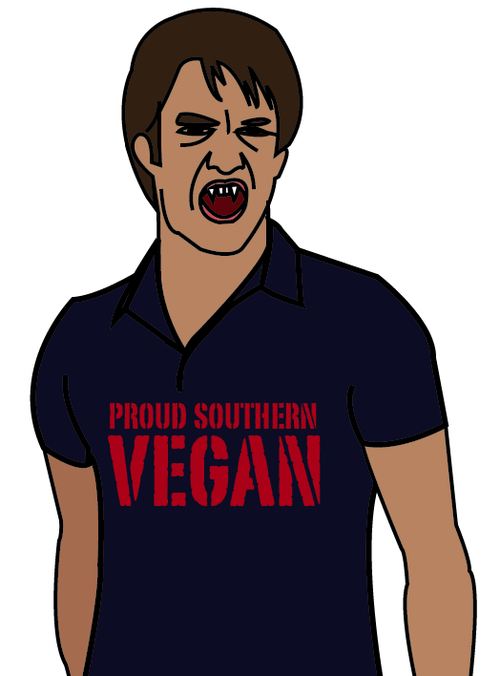
As my sister astutely noted, as we snarked at Edward, “just because you’re not a cannibal doesn’t mean that you’re a vegetarian.” I’m so making a tee shirt that features Edward Cullen’s face and that statement.  Wait for it.

Sunday, February 20, 2011

Valentines and Vegans

The last month has been a blur, and I need things to slow down.  First, the state of North Carolina’s budget situation vacillates between terrifying and out-and-out catatonia producing, so my mind and my energy has been devoted to fighting that (most likely meaningless) fight.  I desperately want to turn my energy back to my teaching and my scholarship, the things about my job that I like, but I keep getting drawn into the discourse of trying to justify my existence.  Have you seen this video?  


It has nothing to do with veganism, but it is so true.  And, at present, that female professor is the embodiment of me.*  But next week is spring break, and if I can just make it until then, I might survive.

* This is not to say that I haven’t also been the little blonde girl with the pigtails.

So let me pull myself out of the mire of the possible dismantling of the public education system as I know it and return to the world of the vegan blog.  Valentine’s Day was pretty swell.  Jason didn’t get me anything as usual, but what’s not usual is that I went into major preemptive bitch mode about the fact that I knew he wasn’t going to get me anything.  I have a friend who calls such behavior “pre-suffering,” and I think that’s about right.  I was, after 13 years of being in a relationship with this boy, suddenly made jealous about the fact that a colleague was discussing the Pajama Gram that he was sending his sweetie.  First of all, I didn’t want a Pajama Gram, not even this one, which would make me look like a giant piece of bubble gum.

But I suddenly wanted something.  What I got was a Valentine’s Day without Jason, as he was at work all freaking day and night, fixing a Valentine’s Day vegan dinner, which I did get to eat for free.  It consisted of the following: first, sweet potato soup with scallion cream cheese and a candied basil leaf; second, chili rubbed seitan and grilled broccolini with smoked Jerusalem artichokes over a savory apple sauce; and for dessert, cocoa risotto beneath coconut tempura banana with a side of Kahlua ice cream.  And it was excellent.  So Jason is forgiven.  He does this every year, and every year the meal is better than the previous one.

Today’s news contains the following top five items when one does a news search for “vegan”:  an article called “What Would Vegan Society Founder Donald Watson Think” about a debate in the UK as to whether animal rights activists should tone down their focus on veganism and speciesism as these stances tend to alienate non-vegans. The author, Gary L. Francione, write about an ad in a Vegan Society publication for a bed and breakfast that serves the likes of poached eggs and Danish with cheese.  He states that Watson, who died in 2005, “coined the word ‘vegan’ and founded the Vegan Society in 1944 precisely because he wanted to emphasize that not eating meat was not enough. He wanted to erase the arbitrary line that had meat on one side and everything else on the other.” He quotes Watson:


The excuse that it is not necessary to kill in order to obtain dairy produce is untenable for those with a knowledge of livestock farming methods and of the competition which even humanitarian farmers must face if they are to remain in business.

For years many of us accepted, as lacto-vegetarians, that the flesh-food industry and the dairy produce industry were related, and that in some ways they subsidized one another. We accepted, therefore, that the case on ethical grounds for the disuse of these foods was exceptionally strong, and we hoped that sooner or later a crisis in our conscience would set us free.

That freedom has now come to us. Having followed a diet free from all animal food for periods varying from a few weeks in some cases, to many years in others, we believe our ideas and experiences are sufficiently matured to be recorded. The unquestionable cruelty associated with the production of dairy produce has made it clear that lacto-vegetarianism is but a half-way house between flesh-eating and a truly humane, civilized diet, and we think, therefore, that during our life on earth we should try to evolve sufficiently to make the ‘full journey’.

A second story, a self-proclaimed “rant” by “veggie girl,” is an “Open Letter to Militant Vegans,” in which she asks militant vegans to “shut the fuck up already.”  Veggie Girl is, as she states, “on your side,” but she ultimately states that

I'm tired of being lumped in with your ilk. My choices are just that -- MINE -- and I respect the rights of others to make their own choices, whether they're vegan, vegetarian, a conscious meat-eater or stop by the drive-through every night. Get off your high horse, shelve the self-righteousness and lead by example. THAT is how you change eating habits -- and lives. Otherwise, you're just an animal-loving version of Fred Phelps. And nobody likes that guy except his fellow church members. And maybe not even them.

So both of these pieces bring into relief the perceived vegan persona, legitimate or not, as alienating and off-putting, as needing to be tempered, as needing to be modified to prevent making the general public from feeling put upon or threatened.  While Veggie Girl does make the claim, however unsubstantiated, between militant and non-militant vegans, the narrative that Veggie Girl and Francione evoke is one that, while they argue from opposing positions, is illustrative of the strange stance that vegans seem forced to occupy, as ethically guided by a belief that animal suffering is preventable and unacceptable yet somehow responsible for the comfort levels of those who disagree.

Other stories: Jessica Simpson is maintaining a vegan diet to lose weight prior to getting married 
And Ryan Couture, some kind of fighter guy, won a fight.  He’s a Los Vegan, which is nothing like being a vegan, but that’s why this story came up.  File that one under who fucking cares…